


Tobi Lütke made his second appearance on the David Senra podcast. They talked about Jensen Huang, software engineering in the AI era, and why free markets are a great societal benefit. Attention Heads is focused on bringing you practical advice to thrive alongside AI, and three mental models from Tobi’s conversation stood out immediately.
Below, I break down those three mental models—and for Attention Heads members, I’ve included links to tools and skills you can install for your agent to put all three into practice today.
1. Prompt Ambitiously
“My main advice is when people are not quite able to get all the value out of this AI-driven development, it’s like usually insufficiently ambitious prompting.”
If you’re the type of person who’s used AI since GPT-3.5, or even earlier models, you’ve likely picked up prompting habits that are now obsolete. You must drop those habits. They hold you back.
Think bigger, wider, and at higher levels of abstraction. Don’t tell the agent how to do something. Tell it what problem you want to solve, and give it space to figure out the best path.
Tobi describes meta-analyzing your prompts. Agent tools like Claude Code and Codex keep historical transcripts of your messages while you work with them. Try asking the agent to analyze your prompts against this article from Felix Rieseberg, Member of Technical Staff at Anthropic, for ideas on how to create more ambitious prompts: “How to be more ambitious: A tutorial for humans with models.”
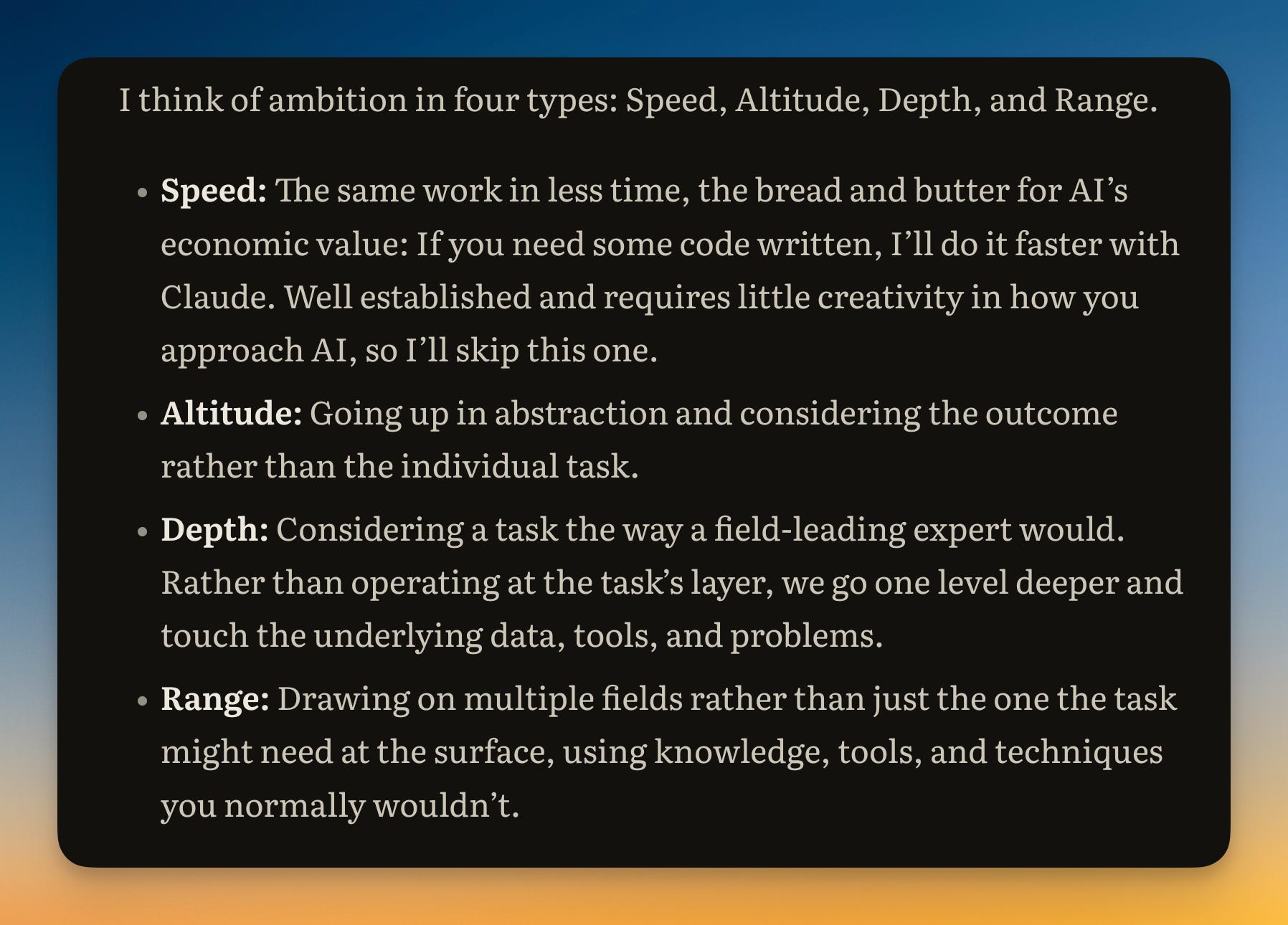
The article is well worth a read in full. Internalize it—it’s a great complement to Tobi’s advice here.
The way I consistently try to raise my ambition is to step above the task level and ask: what problem am I trying to solve that will create real-world value? Then, give that idea to your agent and let it solve the tasks you need to get there. This is where the real leverage lives.
2. Verification as Engineering Discipline
“We had unit tests before. We had static typing before, which are sort of things, at least static typing is sort of formal verification. But the [field] of formal verification is now by far the most important field in engineering.”
For the entire history of software development, writing code was the scarce resource—and because it came slowly, humans could get away with manual code review.
Agents flip that dynamic on its head. Code generation is now abundant, and the scarce resource becomes verification. How do you set up acceptance tests that allow the agent to verify that the code it generated is correct? That’s the job of a software engineer today. You are now a verification engineer.
Lütke doesn’t mention this in the podcast conversation, but this is also relevant to how AI models are trained today. Reinforcement learning (RL) rewards agents when they complete a verifiable task, and they will go to great lengths to hit a verifiable goal (see: the “Hugging Face incident”). When you build a way for your agent to verify its own work, you replicate its RL training environment and give it the exact feedback loop it was trained to excel in.
Here’s a prompt that Tobi shared that you can experiment with today:
Find me all the implicit, ad hoc state machines in my app.
Once it surfaces them, ask it to turn them into a formal spec or TLA+ model—and watch how many edge cases it catches.
3. Agent as Musical Instrument
“There’s no difference between truly the guitar you can pick up just like this and what, I don’t know, Hendrix plays. ... There are people in the world who can play AI at this level who are really understanding the tools...”
Most of us today are using AI as a task accelerator. This is wrong. Think of it as a musical instrument. You wouldn’t pick up a guitar and think, “I need to play these ten notes as efficiently as possible.” That’s not how you make music.
What you want to do is learn how to make music with them. Understand your instrument at a deep level. Learn to make it part of who you are and how you express yourself in the world. This goes beyond engineering into art. That’s the highest manifestation of any creative pursuit.
In the podcast, Senra brings up AlphaGo’s “Move 37”—a masterful, genuinely creative move no human would have thought of. Be open to this when working with agents.
Conduct your agents like an orchestra that can create beautiful music in the abstract world of information, and you will go far beyond merely completing tasks.